As AI workloads grow increasingly power-intensive, traditional backup systems can no longer guarantee reliable, sustainable operation for modern data centers. Fluctuating renewable energy, grid instability, and continuous GPU demand pose new challenges.
This article explores why long-duration energy storage (LDES) is essential for AI data centers, how it addresses operational risks, and what considerations operators should make when selecting storage solutions to ensure uninterrupted, efficient, and resilient performance.
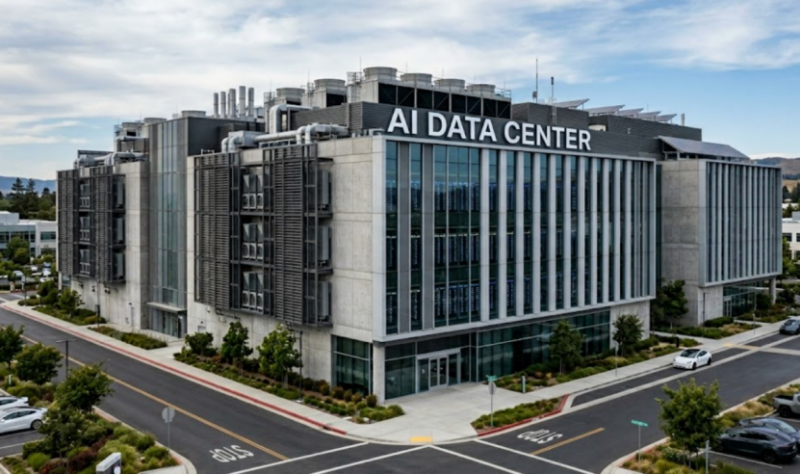
Traditional energy backup systems, such as diesel generators or short-duration batteries, have long served as the safety net for data centers. They provide emergency power when the grid supply fails. However, for modern AI data centers, these solutions are increasingly inadequate.
Traditional backups are designed for short-term outages. Most diesel or UPS-based systems can cover minutes to a few hours of power loss. AI workloads, however, often demand uninterrupted operation for longer periods, especially when renewable energy fluctuations or grid instability occur. Short-duration systems cannot support sustained high-power computation, leaving data centers vulnerable.
Reliance on diesel generators introduces cost and environmental constraints. Running fuel-based backups over extended periods is expensive and produces significant carbon emissions. In a context where sustainability and zero-carbon operations are increasingly prioritized, traditional backups conflict with strategic energy goals.
Conventional battery systems are limited in flexibility and scalability. Standard 1-2-hour battery packs cannot handle the multi-hour, high-demand scenarios typical of AI workloads. Attempting to scale them up leads to complex wiring, increased maintenance, and rising costs.
Traditional backups lack integration with renewable energy sources such as solar and wind. They operate as standalone systems, unable to respond to fluctuations in renewable generation or coordinate with clean energy supply.
This means AI data centers cannot fully leverage clean energy for resilience — even when renewables are abundant, backup systems remain dependent on fossil fuels or grid power. As a result, operators face a trade-off between maintaining reliable backup power and pursuing sustainability goals.
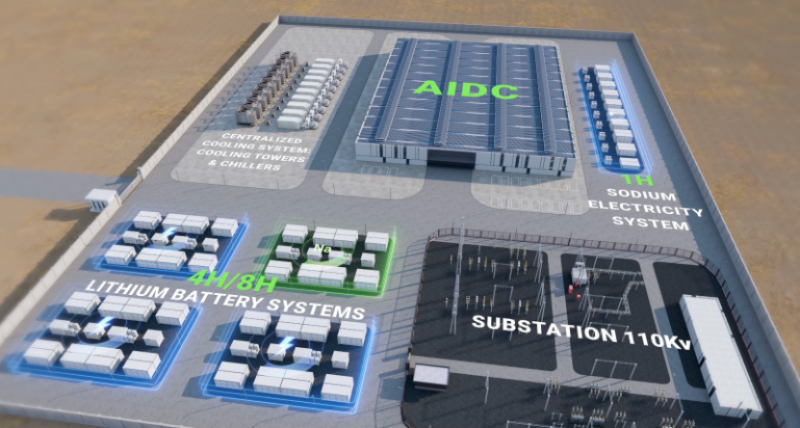
Unlike traditional backups, long-duration energy storagesolves a much broader problem for AI data centers. It helps operators manage energy over longer time windows, reduce operational risk, and build a more stable foundation for high-growth computing demand.
Long-duration energy storage allows AI data centers to maintain operations for much longer than traditional backup systems. Its main advantage lies in duration, giving facilities access to sustained stored energy instead of only brief emergency coverage.
This is especially important for AI data centers with continuous, high-density computing demand, where maintaining power over a longer window can help support essential workloads until normal supply conditions recover.
One of the biggest energy challenges in AI infrastructure is timing. Electricity is not always available in the same pattern as data center demand, especially when renewable energy is part of the supply mix.
This is where long-duration energy storage becomes highly practical. It allows operators to store electricity when supply is abundant or lower cost, then use it later when demand rises, prices increase, or renewable generation falls. In other words, it helps align energy availability with actual operational needs.
Resilience is no longer just about surviving a blackout. For AI data centers, resilience also means staying stable during partial grid instability, supply constraints, or prolonged fluctuations in power quality.
By adding multi-hour storage capability, operators can create a more resilient energy architecture rather than depending entirely on external supply or conventional standby systems. This makes the facility less vulnerable to power disruptions that may not be catastrophic but are still operationally costly.
Long-duration energy storage gives operators more control over long-term energy planning and usage. With multi-hour storage, they can align energy supply with planned workloads, schedule maintenance windows without disrupting operations, and prepare for predictable periods of high demand. This proactive capability supports cost management and operational consistency over extended time frames.
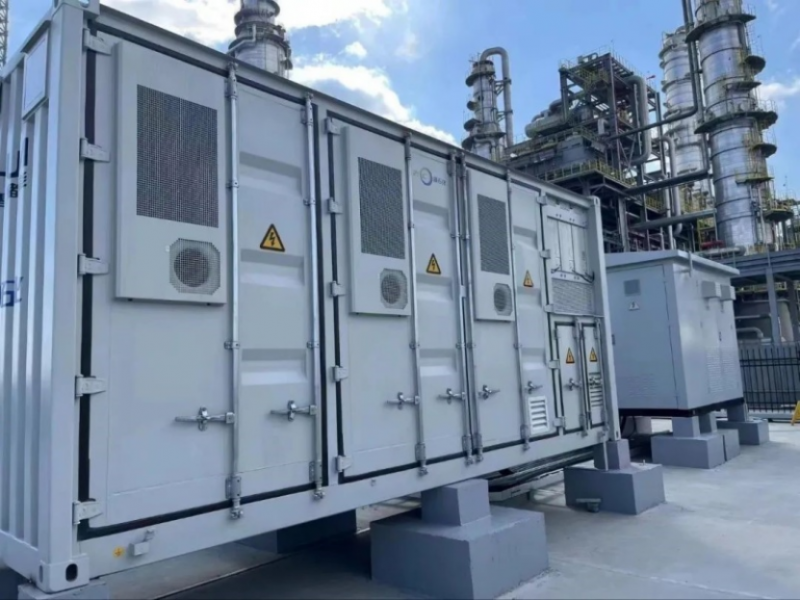
Not all long-duration energy storage (LDES) systems are created equal. Some can cover only a few hours, while others sustain operations for days. For AI data centers with GPU-intensive workloads, ensuring uninterrupted computation requires matching storage duration to operational needs.
l Multi-day storage (100 + hours): Essential for bridging extended periods of low renewable output and ensuring 24/7 operations even during “renewable droughts.”
l Medium-to-long durations (4-24 hours): Ideal for addressing daily peak loads and short-term grid fluctuations, maintaining smooth AI training without interruptions.
l Seasonal or extended storage: Supports autonomous operation over weeks or months when necessary.
Cost efficiency is a critical factor when evaluating LDES options. Systems designed for longer durations typically offer lower lifecycle costs per kWh compared to conventional short-duration batteries. Choosing the right technology ensures operational economics while maintaining high reliability.
l Match duration to actual workload: Verify historical usage and peak demand, then choose a system that exceeds the longest expected outage.
l Optimized for multi-hour operation: Select technologies designed for sustained discharge to reduce reliance on backup generators and short-duration batteries.
l Scalability: Choose a system that allows incremental expansion to meet growing AI power demands without requiring a complete replacement.
l Maintenance and efficiency: Select a low-maintenance, high-efficiency solution to ensure reliable long-term operation and reduce the total cost of ownership.
Safety, space, and siting constraints must also be considered. High-density AI racks pose fire and toxicity risks, and available space may limit deployment options.
l Non-flammable, non-toxic systems: Choose systems that minimize fire and chemical hazards in high-density server rooms to ensure safe operation.
l Flexible deployment: Select solutions that can fit available indoor or adjacent space without compromising safety or performance.
l Geographically suitable solutions: Consider site-adapted technologies such as underground thermal energy storage (UTES) that match local conditions and can efficiently offset cooling loads.
Different LDES technologies have different strengths. Selecting the right one requires considering the workload type, response speed, and flexibility:
l High-power spikes: For rapid GPU load changes, ensure the LDES system can integrate with a fast-response buffer (e.g., small lithium-ion or supercapacitor layer) to smooth sudden spikes.
l Load-shifting and energy arbitrage: Choose systems that allow flexible charging and discharging to store low-cost or surplus renewable energy and release it during peak demand.
l Hybrid compatibility: Choose systems that can operate in hybrid mode (multiple storage layers or combined thermal/electric storage) .
l Long-term reliability: Prioritize systems with proven durability and predictable degradation profiles to ensure consistent performance over many years.
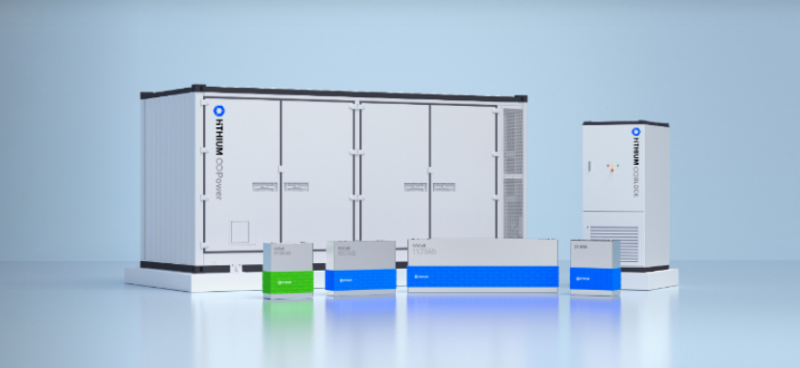
One example of a more deployment-oriented approach is HiTHIUM’s ∞Power Solutions for AI Data Center (AIDC), which includes ∞Power N2.28MWh 1h, ∞Power 6.25MWh 2h, ∞Power 6.25MWh 4h, and ∞Power 6.9MWh 8h.
The solution is built as a multi-duration portfolio rather than a single fixed-format system, covering 1h, 2h, 4h, and 8h configurations. This gives operators greater flexibility when planning for short-term power smoothing, medium-duration backup, and longer-duration energy support across different AI computing scenarios.
The architecture combines high-rate sodium-ion storage with long-duration lithium storage, making it relevant for AI data centers that must manage both rapid load variation and multi-hour energy continuity. This is especially important in facilities where computing loads can change sharply within very short time windows.
Rather than functioning only as a standby backup asset, the solution is positioned around source-grid-load coordination, allowing storage to play a broader role in renewable energy integration, on-site energy balancing, and operational resilience. This makes it more suitable for data centers moving toward lower-carbon and more flexible power architectures.
In longer backup scenarios, the solution also offers a more deployment-oriented alternative to conventional diesel systems. For 4-hour backup applications, HiTHIUM indicates that the lifecycle cost can be more than 20% lower than diesel generators, while also supporting silent and zero-carbon backup operation.
As AI data centers place greater demands on power continuity, flexibility, and sustainability, long-duration energy storage is becoming an increasingly important part of future-ready infrastructure.
By improving backup capability, renewable integration, and energy resilience, LDES can better support evolving operational needs. HiTHIUM has taken a proactive role in this space — launching the "Building the Energy Foundation for AIDC" initiative and co-publishing the 2025 China AIDC Energy Storage Bluebook with leading industry institutions. For operators exploring practical deployment, HiTHIUM and the ∞Power Solutions for AI Data Center (AIDC) represent a solution worth serious consideration.


 Previous: